
Do You Need a 4x4 in Kyrgyzstan? Sedan vs SUV, Route by Route (2026)
Sedan or 4x4 for Kyrgyzstan? Route-by-route verdicts from the WeRent team: the Issyk-Kul ring, gorge roads, Song-Kul, Kel-Suu, the Alay valley and winter - plus an honest comparison of renting your own 4x4 versus joining an organized jeep tour.

Of all the questions that land in our inbox, one outnumbers the rest by a comfortable margin: do I actually need a 4x4 in Kyrgyzstan, or is that just what the jeep-tour brochures want me to believe? The honest answer is the least satisfying kind - it depends entirely on where you are going. This is a country where a smooth modern highway and an unbridged stream ford can sit forty minutes apart, so a blanket "yes" wastes your money and a blanket "no" can leave a sedan beached on a mountain pass. Below we go route by route through the trips our customers actually drive - the Issyk-Kul ring, the gorge roads, Song-Kul, Kel-Suu, the far south and winter - and give each one a plain verdict: sedan is fine, an SUV buys comfort, or four-wheel drive is non-negotiable. Updated for September 2026.
A note on our own bias, since we rent both kinds of car: we at WeRent make no more money steering you into the biggest machine on the lot than into the smallest one that will genuinely do your route. Getting this call right matters more to us than the daily rate - the customer who fights washboard gravel in a low city sedan comes back exhausted, and the one who pays for a serious 4x4 just to circle Issyk-Kul on asphalt has rented ballast. Tell us the route, and we will argue you *down* a class as happily as up one.
The verdicts at a glance
- The Issyk-Kul ring - no. The full loop is paved; any sedan does it all summer long.
- Gorge spurs off the ring (Jety-Oguz, Skazka, Chunkurchak) - an SUV buys comfort and clearance, not survival.
- Altyn-Arashan - the exception among the gorges: genuine 4x4 track, or go up on foot.
- Song-Kul - yes. The passes are gravel serpentines and the weather rewrites them weekly.
- Kel-Suu and the Alay valley - absolutely. Fords, ruts, altitude and no services; this is what 4x4s are for.
- Winter, anywhere near the mountains - yes, whatever the destination. Snow moves every verdict up one class.
Where a sedan is genuinely fine
Start with the good news, because it covers the single most popular trip in the country. The Issyk-Kul ring road is paved for its entire circumference - excellent asphalt along the north shore, older but perfectly drivable asphalt along the south - and the Bishkek-Balykchy highway that feeds it is one of the best roads in Central Asia. Add the run out to the Burana tower, the road into Ala-Archa national park (paved right to the alplager), the city itself, the airport road, and the corridor toward the Kazakh border that our Almaty guide describes - all of it is ordinary asphalt driving. If your two weeks are beaches, Karakol town and the lakeside sights, the smallest car in our fleet will do everything you ask of it and sip fuel while doing so.

Where an SUV buys comfort, not survival
The ring's best moments hide a few kilometres off it, and this is where the middle category lives. The spurs into Jety-Oguz, Skazka canyon, Barskoon gorge and the Chunkurchak valley near Bishkek are gravel: washboard surface, loose stones, the occasional pothole with ambitions. Careful sedan drivers do these roads all summer - slowly, with winces - and we will not pretend otherwise. What a crossover or SUV changes is the experience: real ground clearance turns a teeth-rattling crawl into background noise, and you arrive at the red rocks with your nerves and your oil pan intact. The one gorge that jumps categories is Altyn-Arashan above Ak-Suu: that track is a genuine 4x4 route with rocks and stream crossings, which is why our Karakol guide tells sedan and crossover drivers alike to park in the village and walk up. Know which kind of spur you are pointing at before you leave the ring.
Song-Kul: this is the line
If one destination splits the fleet in two, it is Song-Kul. The lake sits at about 3,000 m, and every approach - Kalmak-Ashuu from the Kochkor side, Moldo-Ashuu from the south - climbs a gravel serpentine that a July rainstorm can turn greasy in an hour. Yes, on a dry August day a confident driver can coax a crossover up, and yes, you will meet the occasional heroic sedan on the plateau; you will also meet the drivers standing beside them, studying a stone that won the argument. Four-wheel drive and clearance mean the pass is a drive rather than a gamble, the weather is an inconvenience rather than a trap, and a change of plan - a different pass down, a detour to another yurt camp - stays on the menu. This is the trip where we stop saying "more comfortable" and start saying "take the 4x4".
Kel-Suu and the far south: no debate
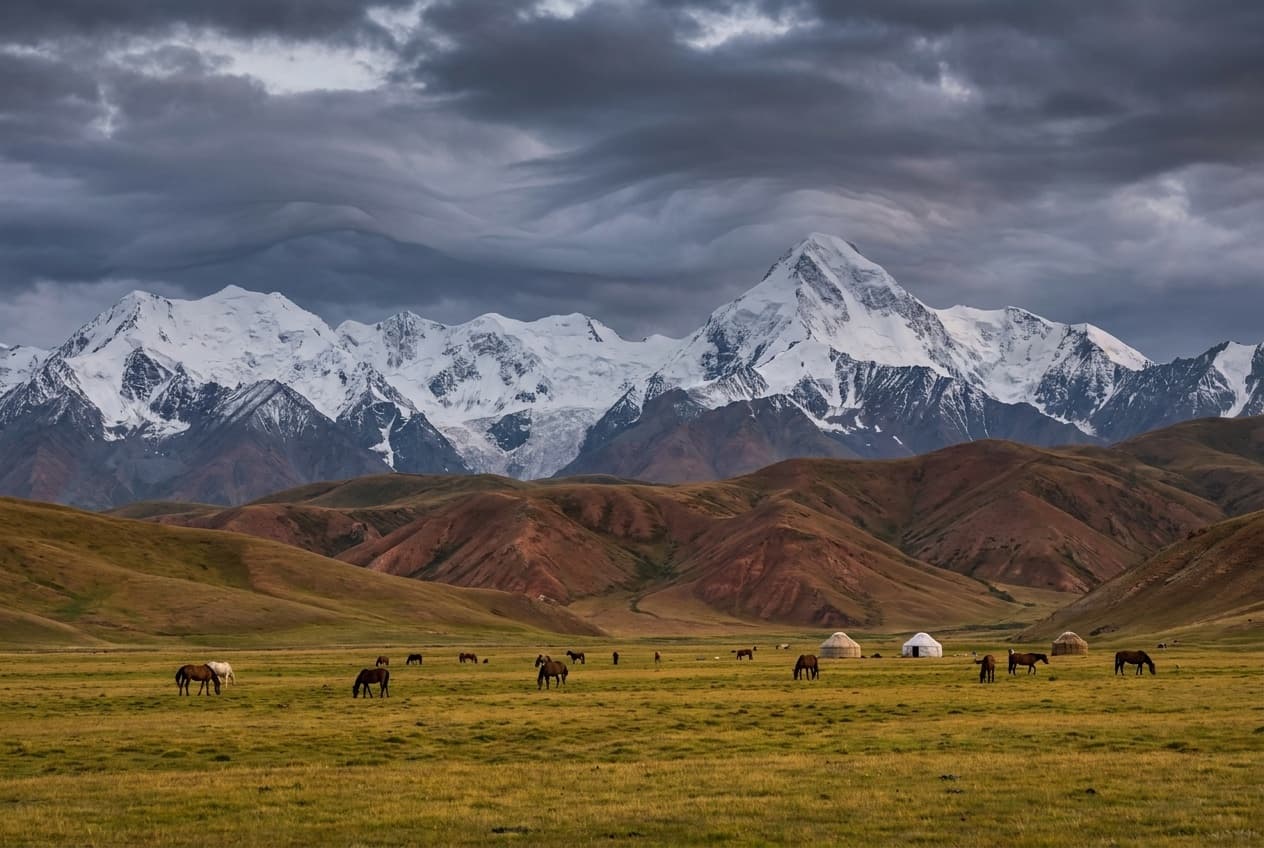
Some destinations do not sit on the sedan-versus-SUV spectrum at all. Kel-Suu is the clearest case: past At-Bashy the route is hours of rutted track and unbridged fords, with no fuel, no signal and quite often no other vehicles - four-wheel drive there is a requirement in the same sense that the border-zone permit is. The Alay valley in the far south plays by the same rules once you leave the main road for the viewpoints facing Lenin Peak, and most side valleys off the high Naryn roads are cousins of the same family. Out here the question is not whether the car can take the abuse but what happens when something goes wrong, and the answer must not depend on a passing stranger with a tow rope. Serious clearance, a full-size spare, and a driver who has read our driving guide - that is the entry ticket.
Winter moves every verdict up a class
Every verdict above assumes summer. From roughly November to March the calculus shifts: mountain roads carry snow and ice for weeks, the Karakol ski base road climbs through switchbacks that are entertaining enough in the dry, and even the flat approach to Issyk-Kul crosses passes that catch weather. Winter cars in our fleet come on proper winter tyres, but tyres solve grip, not geometry - a 4x4 adds the clearance for rutted snow and the traction to pull out of a bad decision. If your trip is a January ski week or any mountain driving between the first snow and the spring melt, book four driven wheels and treat our month-by-month guide as the context for what you will meet up there.
Your own 4x4 or an organized jeep tour?
The alternative to renting a 4x4 is joining an organized jeep tour, and for some travelers that is the right call: a driver who knows every ford, zero navigation stress, company at dinner. But be clear-eyed about the trade. A tour is priced per seat and runs on the group's clock - the itinerary is fixed months ahead, the photo stops are the driver's, and the extra night at a yurt camp you fell in love with is not on offer. A rented 4x4 is priced per car, which a family or two couples split between them, and the schedule is yours alone: leave at dawn or at ten, stay a third night at Song-Kul because the light was extraordinary, skip a stop that bores you, detour because a shepherd waved you toward a better valley. Here is what self-drive buys, in plain terms:
- Your route - every gorge, detour and lunch stop is your decision, not a line in someone's program.
- Your clock - sunrise starts, long evenings, an extra night wherever the trip turns out to be best.
- Per-car economics - one rental split between four travelers, instead of four seats bought separately.
- One car for the whole story - the same 4x4 does the airport, the ring, the passes and the city, with your luggage in it the whole time.
Sedan vs 4x4: FAQ
Can I drive around Issyk-Kul in a regular sedan?
Yes, comfortably - the full ring road is paved, with the north shore in excellent condition and the south shore older but fine. A sedan handles the loop, Karakol, Burana and the Bishkek highways without drama. Only the gravel spurs into the gorges ask for more clearance, and most of those are still passable with care.
Do I need a 4x4 to reach Song-Kul?
We genuinely recommend one. The passes to the lake are gravel serpentines at altitude, and rain turns them slick fast. Crossovers make it up in good conditions, but a real 4x4 turns the pass from a gamble into a drive and keeps your plans flexible when the weather moves - which at 3,000 m it does.
Is an AWD crossover enough, or do I need a proper 4x4?
Think in two ingredients: driven wheels and ground clearance. A crossover has the first and only some of the second, which covers the gorge spurs and, in dry weather, Song-Kul. For Kel-Suu, the Alay valley, Altyn-Arashan or anything with fords and deep ruts, you want both ingredients in full - a proper SUV with real clearance.
Is renting a 4x4 cheaper than an organized jeep tour?
It depends on your group and the tour, so we will not invent numbers - but the structures differ: tours are priced per seat, a rental is priced per car and split between everyone in it. For two couples or a family, self-drive usually compares well, and it buys something no tour sells at any price: your own route and your own clock. Check current rates for your dates in our fleet.
Do I need a 4x4 in Kyrgyzstan in winter?
For any mountain driving between roughly November and March - yes. Winter tyres handle grip on the flat, but snow-packed switchbacks like the Karakol ski base road want clearance and four driven wheels on top. If your winter plans are strictly Bishkek city streets, a sedan on winter tyres is workable; add mountains and the answer flips.
Which trips in Kyrgyzstan truly require a 4x4, no exceptions?
Four stand out: Kel-Suu (hours of rutted track and fords past At-Bashy), the Altyn-Arashan track above Ak-Suu, the side roads of the Alay valley in the far south, and any high-mountain route in winter. Song-Kul sits just below that bar - technically possible without one in perfect weather, strongly recommended with.
So: do you need a 4x4 in Kyrgyzstan? For the ring and the cities, no - and we will cheerfully rent you less car. For Song-Kul, yes; for Kel-Suu, the Alay valley and winter, absolutely; for everything in between, an SUV converts gravel from an ordeal into scenery. The practical move is simple: sketch your route first - our itinerary planner is built for exactly that - then open our fleet, match the car to your hardest day, and tell us in the booking notes where you are headed. Whether that turns out to be a nimble sedan for a lakeside week, a crossover for the gorges, or a serious 4x4 pointed at the high passes, you will be driving the answer to this article's question - your answer, at your own pace, on your own clock.
Planning a trip to Kyrgyzstan? Pick your car and drive worry-free.
Browse the fleetSimilar posts
Kyrgyzstan Itinerary by Car: 7, 10 and 14 Days (2026)
Three field-tested self-drive itineraries for Kyrgyzstan: a 7-day northern loop around Issyk-Kul and Karakol, a 10-day version that adds a yurt night at Song-Kul, and a 14-day plan that brings in Osh and the south - with honest daily driving hours, not optimistic ones.
Driving in Kyrgyzstan: Rules, Roads, Police and Fuel (2026)
Everything you need to know before driving in Kyrgyzstan: license and IDP, speed limits and cameras, the zero-alcohol rule, how police stops actually go, fuel grades and chains, road quality by region, winter driving, and exactly what to do after an accident.

Kel-Suu: Reaching Kyrgyzstan's Wildest Lake (2026)
How to reach Kel-Suu lake in 2026: the border-zone permit and how far ahead to arrange it, the 4x4 route through Naryn and At-Bashy, yurt camps in the Kok-Kiya valley, and the final approach by horse or on foot. An honest guide from the WeRent team.