
Karakol Travel Guide: Gorges, Hot Springs and Ski Season (2026)
Everything we know about Karakol, Kyrgyzstan's best mountain base: the Dungan mosque and wooden cathedral, ashlan-fu at the bazaar, the rough road to Altyn-Arashan's hot springs, Jety-Oguz's red cliffs, the Karakol valley - and the country's biggest ski area in winter.

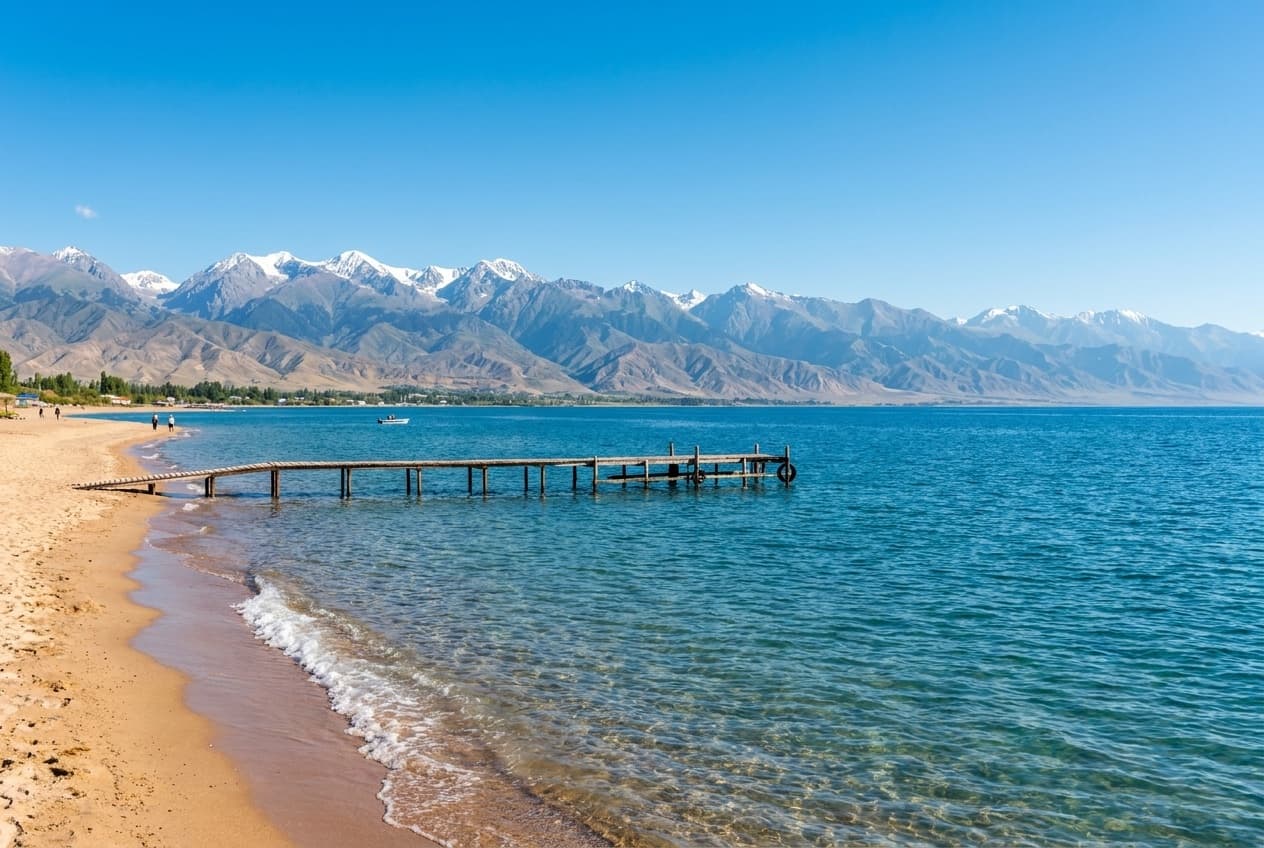
Ask travelers who have crossed Kyrgyzstan to name the place they would go back to first, and a surprising number skip the famous lakes and name a town: Karakol. It sits at the far eastern end of Issyk-Kul, at the foot of the Terskey Ala-Too range, and from its poplar-lined grid of streets you can reach hot springs steaming in a wild valley, a wall of red sandstone cliffs, spruce gorges that run toward glaciers, and - in winter - the biggest ski area in the country. Add the best food scene east of Bishkek and a guesthouse culture that has been quietly perfecting itself for decades, and you get the closest thing Central Asia has to a proper mountain town. This guide covers what to see in town, the three great valleys around it, and how the whole place changes with the snow. Updated for August 2026.
The practicalities first. Karakol is about 400 km from Bishkek along the lake's north shore - a comfortable day's drive with stops, and the natural turnaround point of the Issyk-Kul road trip. Any car we at WeRent rent out will get you to town, to Jety-Oguz and to the ski base; only the Altyn-Arashan track genuinely demands a serious 4x4 or a local transfer, and we will be honest about that below. The town has fuel stations, ATMs, pharmacies and supermarkets - stock up here, because everything east and south of Karakol is villages and mountains.
The town: a garrison grid with a Chinese mosque
Karakol was founded as a Russian garrison town in the 1860s and later renamed Przhevalsk after the explorer Przhevalsky, who died here on the eve of an expedition to Tibet. The imperial grid survives - wide dusty streets, low gingerbread cottages, poplars everywhere - and so do two remarkable wooden buildings. The Dungan mosque, built in 1910 by Chinese Muslim refugees, looks like a Buddhist temple that wandered west: upturned eaves, carved dragons, a pagoda-like silhouette, and - the story every guide tells - not a single nail in the original structure. A few blocks away, the Holy Trinity cathedral answers it in Orthodox key: green domes over honey-colored timber, rebuilt in the 1890s after an earthquake flattened its stone predecessor. Between the two, the bazaar feeds you the town's edible landmark: ashlan-fu, a cold, spicy, vinegary Dungan noodle dish that costs pocket change and cures both summer heat and mountain appetite. A half day covers the essentials:
- The Dungan mosque - still a working mosque; visitors are welcome outside prayer times, dress modestly and leave a small donation.
- Holy Trinity cathedral - go inside for the icons and the smell of old timber; the garden is the town's calmest corner.
- Ashlan-fu alley at the bazaar - a dedicated row of stalls serving one dish; point, sit, add chili and eat it with a fried piroshok like the locals do.
- The Sunday animal market - one of Central Asia's liveliest livestock bazaars, horses and sheep changing hands from dawn; come very early, it winds down by mid-morning.
- Guesthouse dinners - Karakol's family guesthouses grew up feeding trekkers; ask for dinner when you book and you will eat better than in most restaurants.
Altyn-Arashan: hot springs the hard way
Altyn-Arashan - "golden spa" - is a high green valley southeast of town where hot mineral water comes steaming out of the mountainside at about 2,500 m, and a handful of camps have piped it into simple concrete pools. Sitting in hot water under spruce forest and 4,000 m peaks, with the Arashan river roaring past, is one of the great experiences in Kyrgyzstan - and it is guarded by one of the country's most famous bad roads. From the village of Ak-Suu a track of boulders, ruts and stream crossings climbs roughly 15 km up the valley. It is not a test of courage but of clearance: this is genuine 4x4 terrain, driven slowly in first gear, and locals mostly do it in ex-military vans and old Land Cruisers that treat rocks as pavement.
You have three honest ways up. Rent a proper 4x4 and drive it yourself, slowly, in dry weather, accepting that this track is the hardest thing most rental cars in the country ever see. Book a seat in a guesthouse-organized 4x4 shuttle from Karakol - the standard move, and the right one for most travelers. Or walk: the valley is a beautiful half-day hike, about three to four hours up along the river, and the hot pools at the top are twice as good with a climb behind you. Stay the night in one of the simple camps - beds, blankets and dinner, nothing fancy - and you get the valley's best hours, early and late, when the day-trippers are gone and the steam rises into cold air. Fit trekkers use Altyn-Arashan as one end of the famous multi-day route over the Ala-Kul pass to the Karakol valley; that one needs proper gear and acclimatization, not just enthusiasm.
Jety-Oguz: seven bulls and a broken heart
If Altyn-Arashan makes you earn it, Jety-Oguz gives it away. About 30 km southwest of Karakol - asphalt to the village, then a short stretch of easy gravel - a wall of red sandstone cliffs rears out of green pasture: the "Seven Bulls" of the name, with the freestanding Broken Heart rock guarding the valley mouth. Any car does this trip, and an unhurried half day covers it: walk up the ridge opposite the cliffs for the classic panorama, then drive on as the valley opens into wide meadows where herders pitch yurts in summer and sell kumys by the roadside. Keep going and the track eventually roughens toward the Valley of Flowers, carpeted red with poppies in late spring - turn around whenever the road exceeds your car or your patience, because the best views come early. Jety-Oguz pairs perfectly with an afternoon swim on the south shore of Issyk-Kul, twenty minutes back downhill.
The Karakol valley: spruce, glaciers and Ala-Kul
Due south of town, the Karakol valley is the straightest line from your guesthouse to serious mountains. A road runs from the edge of town into the national park - a ranger collects a small cash entry fee at the gate - and continues up the valley floor as decent gravel through dark Tian Shan spruce, with the river for company and 5,000 m summits hiding up the side gorges. Day visitors drive in, park where the road gets rough, and walk: even an easy hour along the river feels properly alpine, and fitter hikers can push on toward the bridges and meadows higher up. This is also the trailhead for the famous trek to Ala-Kul, a turquoise lake locked in rock at about 3,500 m - for acclimatized hikers with camping gear or a booked yurt stop, not a casual day out. For everyone else, the valley itself is the point: it is the closest thing Karakol has to Ala-Archa, and many locals think it is prettier.
Winter: the country's biggest ski area
Around late November Karakol changes costume. Twenty minutes above town, the Karakol ski base is the biggest ski area in Kyrgyzstan: chairlifts rising through spruce forest to open upper slopes, wide cruising pistes, legendary powder between the trees - and, on clear days, a view over the whole blue sweep of Issyk-Kul that alone justifies the lift ticket. By European or Israeli resort standards the infrastructure is modest and the prices feel like a misprint; by any standard the snow is serious, dry and abundant, which is why freeriders from all over the world quietly winter here. The season generally runs from late November into March, snow depending - check conditions locally before you commit. Gear rental exists at the base and in town, guesthouses stay open and warm, and the ashlan-fu tastes even better at -10°C. The road up from town is short but snowy: winter tires and calm winter driving get you there without drama.
Karakol FAQ
How do I get from Bishkek to Karakol?
By car it is about 400 km along the north shore of Issyk-Kul - figure on six hours or so of actual driving, or a full satisfying day if you stop at Burana tower, the gorges and the beaches on the way. The road is asphalt the whole way and any car handles it. Most travelers make Karakol the far point of a lake loop rather than an out-and-back.
Do I need a 4x4 to visit Karakol?
Not for the town, Jety-Oguz, the lower Karakol valley or the ski base - asphalt and easy gravel cover all of that. The one exception is the Altyn-Arashan track, which genuinely requires a serious 4x4 with high clearance; take one, book a local shuttle, or hike up instead.
Can I drive to Altyn-Arashan myself?
Only in a genuine 4x4 with high clearance, in dry conditions, at walking pace - the track from Ak-Suu is about 15 km of boulders, ruts and stream crossings, and it destroys ordinary cars. If that's not the vehicle you have, every Karakol guesthouse can book you into a shared 4x4 shuttle, or you can hike the valley in three to four hours.
When is the ski season in Karakol?
Generally from late November into March, depending on snow - midwinter is the safest bet. The base sits about twenty minutes above town, rents gear on site, and offers the biggest lift-served skiing in Kyrgyzstan, with famously good tree-line powder. Check conditions locally before building a trip around specific dates.
How many days does Karakol deserve?
Two nights is the honest minimum: half a day for the town and bazaar, a day for Jety-Oguz or the Karakol valley. Three or four nights lets you add an overnight at Altyn-Arashan's hot springs - the thing most travelers end up rating as their Kyrgyzstan highlight. Trekkers heading for Ala-Kul should add more.
Is Karakol worth visiting in winter if I don't ski?
Yes, with expectations set: the town is quiet, cold and atmospheric, the mosque and cathedral look their best under snow, guesthouses are warm and cheap, and you can ride the lift up for the Issyk-Kul view without ever clicking into skis. Jety-Oguz is reachable in winter with care; Altyn-Arashan and the high valleys are for the properly equipped only.
Karakol rewards the way we like to travel: one good base, a full tank, and a different valley every morning. Drive out along the Issyk-Kul loop, give the town its two or three nights, soak at Altyn-Arashan, stand under the Seven Bulls - and if the snow is falling, bring your ski gloves. Check the rental basics in our FAQ, then pick your car from our fleet: anything for the lake road, something serious with four driven wheels if the hot springs are calling. The pools are hot, the powder is dry, and the ashlan-fu is waiting.
Planning a trip to Kyrgyzstan? Pick your car and drive worry-free.
Browse the fleetSimilar posts
Osh and the South: Sulaiman-Too, Arslanbob and the Alay Valley (2026)
A driving guide to southern Kyrgyzstan: Osh and its UNESCO-listed Sulaiman-Too, the Jayma Bazaar, the Karakhanid minaret at Uzgen, the walnut forests of Arslanbob, and the Alay valley with Lenin Peak on the horizon - plus the fly-to-Osh-and-rent-there play.
Issyk-Kul Road Trip: Driving the Full Loop Around the Lake (2026)
The complete self-drive guide to Kyrgyzstan's great lake: an ~800 km loop from Bishkek through Cholpon-Ata, Karakol and the wild south shore. Day-by-day stops, honest road conditions, where to fill up - and whether you really need a 4x4.

Kyrgyzstan Itinerary by Car: 7, 10 and 14 Days (2026)
Three field-tested self-drive itineraries for Kyrgyzstan: a 7-day northern loop around Issyk-Kul and Karakol, a 10-day version that adds a yurt night at Song-Kul, and a 14-day plan that brings in Osh and the south - with honest daily driving hours, not optimistic ones.