
Best Time to Visit Kyrgyzstan: Month by Month (2026)
When is the best time to visit Kyrgyzstan? A month-by-month guide from the WeRent team: when the Song-Kul passes open, when Issyk-Kul is warm enough to swim, when Karakol's ski season runs - and why June and September are the two windows we would book first.

"When should we come?" is the question we get more than any other, and the honest answer starts with a question back: what do you want the mountains to be doing? Kyrgyzstan is a vertical country - the Fergana lowlands around Osh sit near 1,000 m while the road passes climb beyond 3,000 - so the seasons arrive floor by floor, weeks apart. There is no bad month to land in Bishkek, but there are months when Song-Kul is a snowfield, months when Issyk-Kul is warm enough to swim before breakfast, and exactly two windows when the whole country works at once. This guide walks the full calendar. Updated for August 2026.
One thing colors every verdict below: this is a road-trip country, so for us a month is "good" when the driving is good - passes open, daylight long, weather readable. We at WeRent hand over cars in Bishkek and Osh twelve months a year, and the same lake loop that is a swimming holiday in August is a moody, empty photographer's road in October. If you are still choosing how long to come for, our 7, 10 and 14-day itineraries pair naturally with the calendar on this page.
The short answer: June or September
If we could hand you two boarding passes, they would say June and September. June is the country switching itself on: the valleys are at their greenest, snow still crowns everything above 3,500 m, the roads to Song-Kul open around the middle of the month, and the summer crowds have not landed yet. September is the same film run in reverse and shot in gold: the weather settles into its most stable stretch of the year, Issyk-Kul holds its summer warmth for weeks after the beach season ends, the pastures turn amber, and the yurt camps stay up until roughly the middle of the month. July and August are wonderful too - they are simply the months everyone else has already chosen.
The year, month by month
- January - deep winter: short days, proper cold, and the ski season around Karakol in full swing. Bishkek's air can turn smoggy in the coldest weeks, so spend your days in the mountains, not the city.
- February - the cold holds, the slopes stay reliable, and the country is at its quietest. A good month for skiers and for nobody's first visit.
- March - the thaw begins from the bottom up. Nooruz, the spring equinox holiday on 21 March, fills the squares; the mountains answer with slush and mud.
- April - the foothills go green and the south wakes first: around Osh the orchards blossom while the northern passes are still shut. Lowland sightseeing weather, not yurt weather.
- May - the north switches on: the Issyk-Kul loop is green, poppies streak the hillsides, prices are low. Expect showers, and leave Song-Kul off the plan - it is not ready yet.
- June - the first golden window. The high passes open around mid-month, the days are at their longest, and everything is green at once. Our pick for scenery.
- July - everything is open and everyone knows it. The yurt camps hum, Bishkek and Osh bake in the afternoons, and the swimming season on Issyk-Kul begins in earnest.
- August - high summer: the warmest water of the year in Issyk-Kul, the fullest campsites, and short afternoon storms in the high mountains. Book cars and yurts well ahead.
- September - the second golden window: the year's steadiest weather, a still-warm lake, amber pastures and thinning crowds. The Song-Kul camps fold around mid-month; below them, everything keeps working.
- October - autumn on the valley floors: golden poplars, the walnut harvest around Arslanbob, empty roads, first snow up high. Beautiful and increasingly limited - stay low and you will love it.
- November - the gap month: grey below, wintry above, the ski lifts not yet turning. If your dates are flexible, this is the one month we would move.
- December - winter settles in and the season around Karakol opens; the New Year holidays bring lights to Bishkek and the first proper powder to the slopes.
Summer, June to August: the everything window
From roughly mid-June to mid-September, Kyrgyzstan is a country with no locked doors: the passes to Song-Kul are open, the herder families are up on the summer pastures with their yurts, and the whole 700 km ring around Issyk-Kul is in season. The lake itself never freezes - the name means "warm lake" - but it is only truly swimming-warm in July and August, which is exactly when the beaches of Cholpon-Ata are at their fullest and the cities at their hottest. Our summer formula is simple: sleep by the water or above 2,000 m, do the driving in the morning, and keep afternoons for beaches, gorges and thunderstorm-watching. It is also the season when a 4x4 earns its keep, because the best summer nights sit at the top of gravel switchbacks.

September and October: the connoisseur's autumn
Ask anyone on our team for a private recommendation and you will hear the same word: September. The summer storm cycle winds down, the light turns long and golden, the lake keeps its warmth while the beach crowds vanish, and towns like Karakol get their streets back. Early in the month you can still catch a yurt night at Song-Kul; after the camps fold, the Issyk-Kul ring, the gorges and the south remain fully open. October narrows the map but deepens the colors - poplar-lined roads in full gold, the walnut harvest filling Arslanbob's forest with families - and by then you will often have viewpoints entirely to yourself. The trade: shorter days, cold nights, and the need to check conditions before any road that crosses 3,000 m.
Winter, December to March: ski Karakol, keep plans low
Winter Kyrgyzstan is a different, quieter product - and for the right traveler, a great one. The ski base above Karakol runs from roughly December to the end of March, with big-mountain views and lift tickets that feel refreshingly modest by Alpine standards; the Issyk-Kul north-shore road stays open and plowed all winter, so reaching it with your own car is entirely realistic. Closer to the capital, Ala-Archa's spruce forest under snow is the best half-day in the country, and the small resorts of the Chunkurchak area cover a family weekend. Two honesty notes: Bishkek's air quality drops noticeably in the coldest weeks, and everything above the plowed roads - Song-Kul first of all - is closed until June. Read the winter section of our driving guide before you book.
Spring, April and May: green, moody, underrated
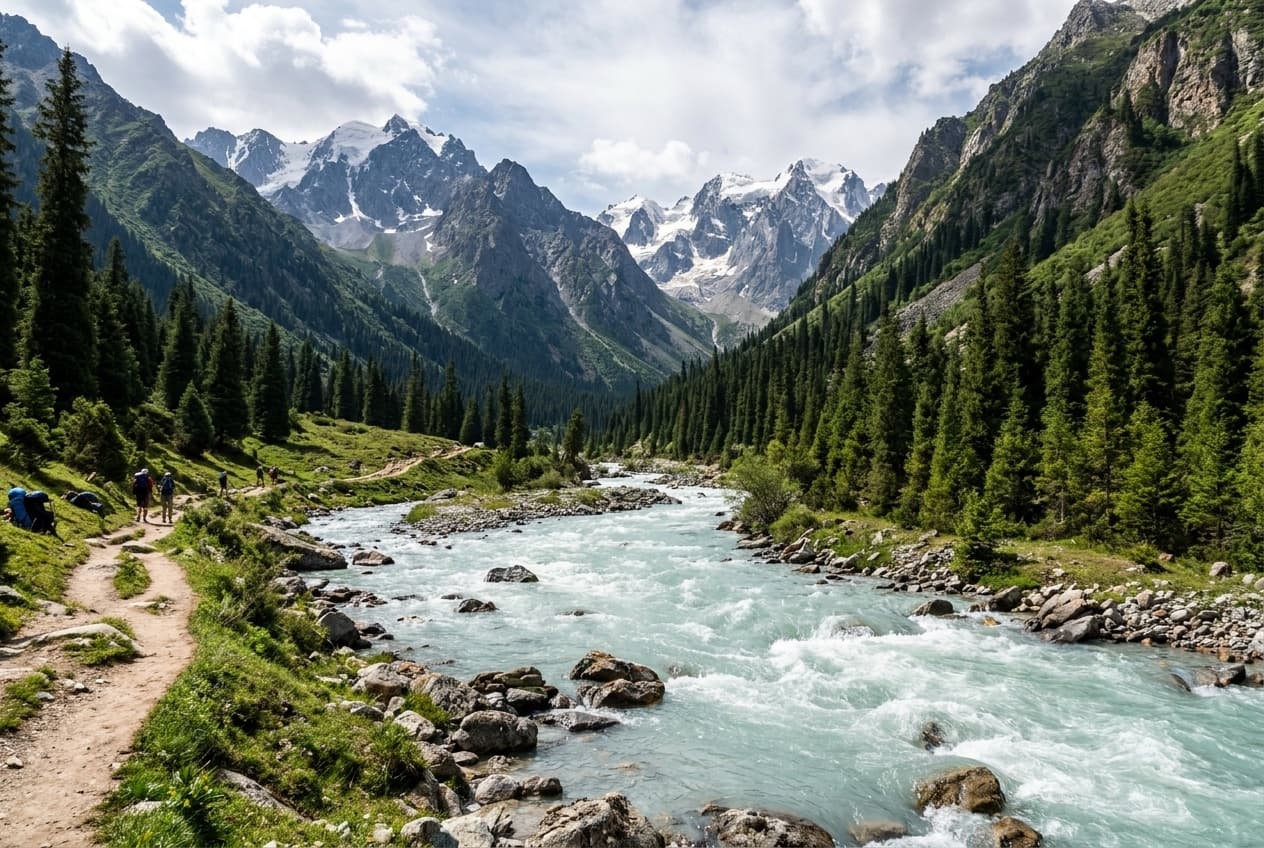
Spring is the wildcard. The reward is a Kyrgyzstan almost nobody photographs: foothills in a green you will not believe, wildflowers running up the slopes as the snowline retreats, full rivers, empty guesthouses and low prices. The cost is weather that changes its mind by the hour and a high country that is still asleep. Our spring play is a south-weighted trip - fly into Osh while the Fergana rim is in blossom, then work north as the season climbs - or a relaxed lake loop in late May with a flexible plan and a safety-guide level of respect for mountain forecasts. Just do not build a spring trip around a place above 3,000 m and you will come home delighted.
Best time to visit Kyrgyzstan: FAQ
What is the single best month to visit Kyrgyzstan?
If we had to pick one, September: the year's most stable weather, a still-warm Issyk-Kul, golden valleys, thinning crowds, and - in the first half of the month - a last chance at a Song-Kul yurt night. June is the runner-up, greener and fresher but with slightly less settled weather. July and August win only if lake swimming is the heart of your trip.
When can you swim in Issyk-Kul?
The reliable swimming window is July and August, when the water reaches its warmest and the north-shore beach resorts are in full season. Hardy swimmers extend it from mid-June into early September - the lake holds summer heat remarkably well. It never freezes, but outside those months a swim is a dare, not a holiday activity.
When is Song-Kul accessible by car?
Roughly from mid-June to mid-September - the only season when the passes are clear of snow and the yurt camps are standing. Outside that window the tracks are closed or genuinely dangerous, and there is no infrastructure at the lake at all. Even in season, take a 4x4 and check conditions in Kochkor on the way up.
Is winter worth it if I don't ski?
For a short city-plus-mountains break, yes: snowy Ala-Archa, a quiet drive along the lake's north shore, hot springs and half the usual visitors make a fine long weekend. For a first, full Kyrgyzstan trip, no - too much of what makes the country special is behind snowed-in passes until June. Come in winter for atmosphere, in summer for the country.
Which month should I avoid?
November is the weakest hand: autumn is over in the valleys, the ski season has not started, and the high country is already shut. Late March has a similar in-between feel, with slush where the snow is melting. Neither ruins a trip built around Bishkek, Osh and low-altitude sights - they are simply the months when Kyrgyzstan shows you the least for your time.
Is July or August too hot or too crowded?
Hot in the cities, yes - Bishkek and especially Osh bake on midsummer afternoons - but the classic routes spend their days at lake level or higher, where the heat is easy and the evenings are cool. Crowded is relative: the north shore of Issyk-Kul fills with regional holidaymakers, yet a gorge two valleys over can be empty. Book early, start driving early, and midsummer works beautifully.
So: June or September if you can, July or August for the beach-and-yurt classic, December to March for the snow, and April, May or October for a Kyrgyzstan that feels like your own discovery. Whichever window you choose, the method is the same - match the route to the season, check the rental basics in our FAQ, and pick the right machine from our fleet: any car for the lake in summer, four driven wheels the moment your plan climbs past the asphalt. The mountains keep their own calendar; with your own car, at least the schedule is yours.
Planning a trip to Kyrgyzstan? Pick your car and drive worry-free.
Browse the fleetSimilar posts

Do You Need a 4x4 in Kyrgyzstan? Sedan vs SUV, Route by Route (2026)
Sedan or 4x4 for Kyrgyzstan? Route-by-route verdicts from the WeRent team: the Issyk-Kul ring, gorge roads, Song-Kul, Kel-Suu, the Alay valley and winter - plus an honest comparison of renting your own 4x4 versus joining an organized jeep tour.
Kyrgyzstan Itinerary by Car: 7, 10 and 14 Days (2026)
Three field-tested self-drive itineraries for Kyrgyzstan: a 7-day northern loop around Issyk-Kul and Karakol, a 10-day version that adds a yurt night at Song-Kul, and a 14-day plan that brings in Osh and the south - with honest daily driving hours, not optimistic ones.
Driving in Kyrgyzstan: Rules, Roads, Police and Fuel (2026)
Everything you need to know before driving in Kyrgyzstan: license and IDP, speed limits and cameras, the zero-alcohol rule, how police stops actually go, fuel grades and chains, road quality by region, winter driving, and exactly what to do after an accident.